According to Sport England’s recent Active Lives Adult Survey Report, the number of people playing sport and taking part in some form of physical exercise is at the highest level on record. It states that 63.7% of the adult population – that’s around 30 million people – met the recommended guidelines of doing 150+ minutes of moderate intensity physical activity every week.
Gyms and other indoor fitness centres have seen an increase in membership which isn’t entirely due to January’s inevitable post-Christmas resolutions to get up off the sofa and move about a bit more! There’s a particular growth in the attendance of Gen Z, who have a definite interest in prioritising health and fitness.
As a result, there’s been an explosion in the number of indoor sports venues opening across the UK. Many large corporate organisations offer onsite fitness facilities, and some businesses provide gym membership as an employee perk and to boost wellbeing. Fitness franchises are opening up new branches including trampolining parks and climbing centres and, as you may have read in our other blogs, padel tennis and pickleball courts, both indoor and outdoor, are growing rapidly.
In order to ensure users of all these amenities stay injury-free, one of the most important considerations for business owners when fitting them out is getting the right type of flooring for each particular activity.
What is the right type of flooring?
Safety and optimal performance are the key elements when specifying flooring, as different sports require different types. A gym will contain heavy equipment which necessitates a floor capable of coping with this and with large weights occasionally dropped from a height!
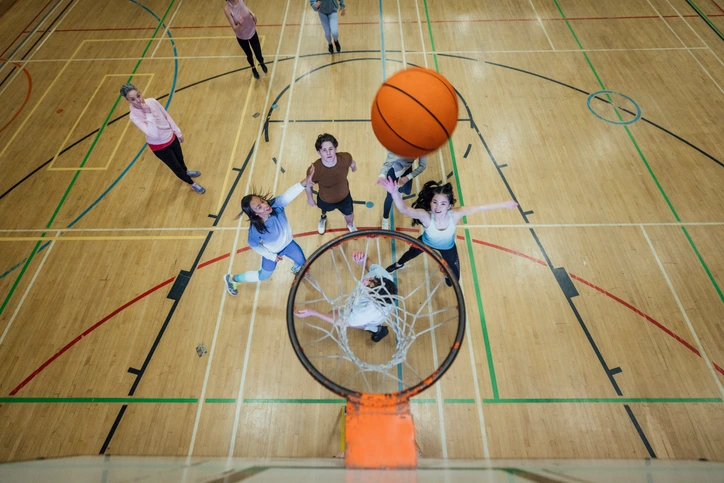
A basketball court will have feet pounding up and down so will need to be durable. Padel courts require a high-performance surface which gives a consistent ball bounce. Flooring for swimming pools and changing areas will need to be self-draining and mould-resistant. Facilities within multi-purpose buildings will need to have floors with good acoustic absorption, and a quality sports floor should also have shock-absorbent properties to protect users’ joints and tendons.
We do also have to mention hygiene – there’s a lot of sweat produced in sports venues so moisture-proofing and anti-bacterial properties are important. Nobody wants to attend a whiffy gym.
Finally, the top priority for any sports surface is that it has to be non-slip. No venue can afford to be found liable for a slip injury.
Flooring standards
The UK Health & Safety Executive has various standards for sports flooring. HSE’s HSG179 sets out guidance for non-slip flooring in wet areas with different standards for areas where people wear shoes and areas where they will be barefoot.
EN 14904 (indoor multi-use) is mandatory and covers performance, such as ball bounce and shock absorbance, safety including fire resistance, and surface evenness. It classifies sports floors by their elasticity:
- Area-elastic systems which provide shock absorption over a larger area.
- Point-elastic systems which absorb impact at the point of contact.
- Combined systems which are a combination of the above two for all-round adaptability
The standard defines minimum thresholds for shock absorption, ball rebound and deformation, requiring rigorous testing for certification. Meeting EN 14904 requirements assures users the floor is suitable for a wide range of sports and activities.
Materials
Having established the type of sport and the legislation which governs flooring for it, a sports business owner can then look more specifically at the type of material which is going to give the optimal result – and stand the test of time. There are a number of options including:
Hardwood timber
This has a classic appearance and offers good durability, although the downside is that its toughness can also be unforgiving on joints.
Polyurethane
This is the premium synthetic sports surface, known for its durability and seamless appearance but with the added advantage of cushioning, which reduces the risk of injury. It’s also easy to clean.
Vinyl
Vinyl is a good alternative to polyurethane where a specialised elasticity is needed for particular sports. It’s less durable than polyurethane but cheaper.
Rubber
This is a good choice for high impact areas like gyms, as it’s extremely durable, resists mould and has good sound dampening properties. It’s also a flexible choice if modular rubber tiles are specified, as in the event of damage, a single tile can be easily replaced.
It’s important to point out that a successful sports floor is totally dependent on the quality of the underlying sub-floor. It has to be completely level, dry and sound before the flooring is laid or the whole area will be unusable.
Sports flooring sustainability
Flooring sustainability is something we’re hearing a lot more about as businesses try to reduce their carbon impact and make informed choices on sustainable products.
For wood flooring, customers can specify hardwood from PEFC-certified or responsibly-managed forests.
Synthetic flooring is often made of recycled materials. Rubber tiles can be made from car tyres, and linoleum made from natural materials which are completely recyclable is a sustainable option. Eco-friendly vinyl tiles are made from recycled materials with low emission of volatile organic compounds (VOCs).
As mentioned above, the use of modular tiles makes it easy to replace small sections of damaged flooring, which is not only cost-effective but also reduces waste.
The sports floor experts
Oakwhite has completed numerous successful fit out and refurbishments for all kinds of sports facilities across the UK – it’s one of our biggest sectors. We’d love to help you with yours. Contact us for chat with a member of our team.